
Custom Stickers & Labels: The Complete Printing Guide
Custom stickers and labels are one of the most versatile, cost-effective print products available, and getting them made professionally is simpler than most people expect. Whether you need branded product labels, promotional stickers for an upcoming event, or custom decals for personal projects, the right print provider handles the heavy lifting from file to finished product.
This guide covers everything you need to know before placing a custom sticker or label order. You will learn about material options, printing methods, file preparation requirements, sizing, finishes, turnaround times, and pricing, all written for customers in Dallas, TX who want reliable results without the guesswork.
From choosing between vinyl and paper stock to understanding the difference between die-cut and kiss-cut, every decision point is explained clearly so you can move forward with confidence and get exactly what you need.
What Are Custom Stickers and Labels? 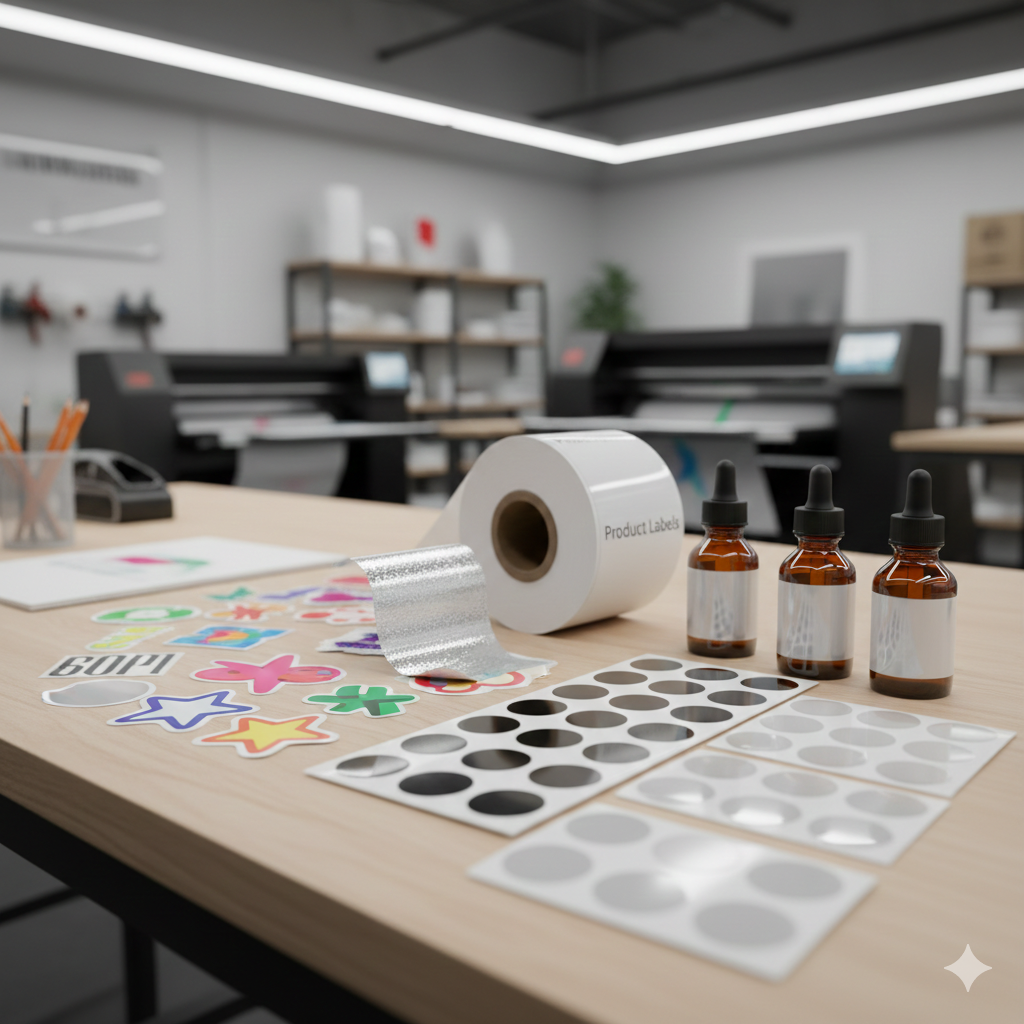
Custom stickers and labels are printed adhesive products made to your exact specifications. They are produced using your own artwork, logo, text, or design and applied to surfaces like packaging, products, vehicles, walls, windows, and promotional materials. Unlike generic, off-the-shelf options, custom-printed stickers and labels let you control the size, shape, material, color, and finish to match your specific purpose.
Both stickers and labels use pressure-sensitive adhesive backing, but they serve different functions and are designed with different end uses in mind. Understanding the distinction helps you order the right product and avoid unnecessary costs.
Stickers vs. Labels: Key Differences
The terms "sticker" and "label" are often used interchangeably, but in the printing industry, they refer to slightly different products.
Stickers are typically designed for promotional, decorative, or branding purposes. They are often handed out individually, applied to laptops, water bottles, packaging inserts, or used as part of marketing campaigns. Stickers tend to prioritize visual impact and durability.
Labels are functional. They are applied directly to products, packaging, envelopes, jars, bottles, or boxes to communicate information such as ingredients, barcodes, addresses, or brand identity. Labels are usually produced on rolls or sheets for efficient application.
Feature Stickers Labels
| Primary Purpose | Promotion, branding, decoration | Product identification, information |
| Typical Format | Individual cut pieces, sheets | Rolls, sheets |
| Application | Hand-applied, giveaways | Applied to products, packaging |
| Design Focus | Visual impact, creativity | Clarity, compliance, branding |
| Common Shapes | Die-cut, custom shapes | Rectangles, circles, ovals |
In practice, the production process is nearly identical. The difference comes down to intent and application.
Common Uses for Custom Stickers and Labels
Custom stickers and labels serve a wide range of purposes across personal, professional, and commercial applications.
Business and branding uses include product packaging labels, branded shipping stickers, window decals for storefronts, and promotional giveaway stickers. Small businesses in Dallas frequently use custom labels to give their products a polished, professional appearance without investing in expensive packaging.
Event and marketing uses include event badges, name tags, floor decals, bumper stickers for campaigns, and promotional stickers distributed at trade shows, festivals, or community events.
Personal and creative uses include laptop stickers, water bottle decals, wedding favor labels, return address labels, and custom designs for gifts or craft projects. Students and individuals often order small batches for personal expression or one-time events.
Organizational uses include inventory labels, asset tags, safety and compliance labels, and warehouse identification stickers.
Types of Custom Stickers and Labels
Not all stickers are made the same way. The type you choose affects how the sticker looks, feels, and performs. Here is a breakdown of the most common types available through professional print providers.
Die-Cut Stickers
Die-cut stickers are cut precisely along the outline of your design, removing all excess backing material. The result is a sticker shaped exactly like your artwork, whether that is a logo, mascot, icon, or custom illustration.
Die-cut stickers look clean and professional. They are popular for brand stickers, laptop decals, product packaging, and giveaways. Because the sticker shape matches the design, they create a high-end, intentional appearance.
Die-cutting works best with bold, simple shapes. Extremely intricate outlines with thin extensions can be more fragile and may require design adjustments.
Kiss-Cut Stickers
Kiss-cut stickers are cut through the sticker material but not through the backing sheet. The sticker peels away from a larger rectangular or square backing, making it easy to handle and distribute.
This format is ideal for sticker sheets with multiple designs, promotional handouts, and retail packaging inserts. Kiss-cut stickers are easier to peel than die-cut stickers, which makes them a practical choice for customers who will be applying them quickly.
Kiss-cut is also the preferred method for sticker sheets where several small stickers are arranged on a single backing.
Vinyl Stickers and Decals
Vinyl stickers are made from a durable synthetic material that resists water, UV exposure, and general wear. They are the go-to choice for outdoor applications, vehicle graphics, window decals, and any situation where the sticker needs to last.
Vinyl decals can be produced with a permanent or removable adhesive, depending on whether the application is meant to be long-term or temporary. They maintain color vibrancy and adhesion far longer than paper-based alternatives.
For businesses in Dallas, vinyl stickers and decals are commonly used for storefront window graphics, fleet vehicle branding, and outdoor signage elements.
Bumper Stickers
Bumper stickers are a specific format of vinyl sticker designed for vehicle application. They are typically rectangular, measuring around 3 x 10 inches or 3.75 x 7.5 inches, and printed on weather-resistant vinyl with UV-protective lamination.
Bumper stickers are used for political campaigns, business promotion, community organizations, and personal expression. They need to withstand sun, rain, car washes, and temperature fluctuations, which is why professional-grade vinyl and lamination are essential.
Product Labels
Product labels are designed to be applied to physical goods, packaging, bottles, jars, boxes, bags, and containers. They communicate brand identity, product information, ingredients, barcodes, regulatory details, and usage instructions.
Product labels are typically printed on rolls for efficient application, especially for businesses producing goods in volume. Material choices range from paper to waterproof vinyl, depending on the product environment. A candle label, for example, needs heat resistance, while a bath product label needs waterproof material.
For small businesses and makers in Dallas selling at local markets, pop-up shops, or online, professional product labels are one of the fastest ways to elevate perceived quality.
Roll Labels
Roll labels are produced on continuous rolls rather than individual sheets. They are designed for high-volume application, either by hand or with a label applicator machine.
Roll labels are the standard format for product packaging, shipping labels, and any application where hundreds or thousands of labels need to be applied efficiently. They can be produced in virtually any size, shape, and material.
Ordering labels on rolls typically reduces per-unit cost compared to sheet labels, making them the most economical option for businesses with ongoing labeling needs.
Clear and Transparent Stickers
Clear stickers are printed on transparent vinyl or polyester film, allowing the surface beneath the sticker to show through. Only the printed design and any white ink underlay are visible.
This creates a "no-label" look that is popular for product packaging, window applications, and minimalist branding. Clear stickers work best on smooth, light-colored surfaces where the transparency effect is most visible.
When ordering clear stickers, it is important to specify whether you need a white ink layer behind your design. Without white ink, colors printed on clear material will appear translucent and may shift depending on the surface color.
Sticker and Label Materials Explained
Material selection is one of the most important decisions in the custom sticker and label printing process. The material you choose determines durability, appearance, feel, and suitability for your intended application.
Paper-Based Materials
Paper sticker and label stock is the most affordable option and works well for indoor applications with a limited lifespan. Common paper stocks include matte white, glossy white, and kraft (brown) paper.
Paper labels are widely used for product packaging, mailing labels, name tags, and promotional stickers that will be used indoors or have a short-term purpose. They accept ink well and produce sharp, vibrant prints.
The main limitation of paper is durability. Paper stickers are not waterproof, tear more easily, and fade faster when exposed to sunlight. They are not recommended for outdoor use or products that will encounter moisture.
Vinyl and Synthetic Materials
Vinyl is the most popular material for durable custom stickers and labels. It is waterproof, tear-resistant, and UV-resistant, making it suitable for both indoor and outdoor applications.
Standard white vinyl provides an opaque base for full-color printing. Clear vinyl allows for transparent designs. Specialty vinyl options include metallic, holographic, and textured finishes.
Synthetic materials like BOPP (biaxially oriented polypropylene) offer similar durability to vinyl at a lower cost and are commonly used for product labels, especially in the food, beverage, and personal care industries.
Specialty Finishes: Matte, Gloss, and Laminated
The finish applied to your sticker or label affects both appearance and protection.
Matte finish provides a smooth, non-reflective surface. It gives stickers a modern, understated look and reduces glare, making text easier to read. Matte finishes are popular for premium branding and minimalist designs.
Gloss finish creates a shiny, reflective surface that makes colors appear more vibrant and saturated. Gloss is a strong choice for stickers with bold graphics, photographs, or designs where color pop is a priority.
Laminated finish adds a protective layer over the printed surface. Lamination significantly increases scratch resistance, UV protection, and water resistance. For stickers that will be handled frequently or used outdoors, lamination is strongly recommended.
Waterproof and Weather-Resistant Options
For any sticker or label that will be exposed to water, humidity, extreme temperatures, or direct sunlight, waterproof materials and finishes are essential.
Waterproof stickers are typically printed on vinyl or BOPP with a laminated finish. This combination resists moisture, prevents ink from running or smearing, and protects against UV fading.
Common applications for waterproof stickers and labels include outdoor signage, vehicle decals, product labels for beverages and bath products, cooler stickers, and equipment labels. In the Dallas climate, where summer heat and sun exposure are significant factors, waterproof and UV-resistant materials are especially important for any outdoor application.
How Custom Stickers and Labels Are Printed
Understanding the printing process helps you make better decisions about your order and communicate more effectively with your print provider.
Digital Printing
Digital printing is the most common method for custom stickers and labels, especially for short to medium print runs. It works by transferring your digital design file directly to the printing surface without the need for plates or screens.
Digital printing offers several advantages for custom sticker production. It supports full-color printing (CMYK) with no minimum color requirements, allows for variable data (each sticker can have different text or images), and requires minimal setup, which keeps costs low for smaller quantities.
Most professional print shops, including those in Dallas, use high-resolution digital printers capable of producing sharp detail, accurate color reproduction, and consistent quality across the entire run.
Large-Format and Wide-Format Printing
Large-format printing is used for oversized stickers, decals, wall graphics, floor graphics, and vehicle wraps that exceed standard sticker dimensions. Wide-format printers can produce prints several feet wide, making them essential for window graphics, wall murals, and large promotional decals.
Large-format stickers and decals are typically printed on vinyl using eco-solvent or UV-curable inks, which provide excellent outdoor durability and color vibrancy. This printing method is commonly used for storefront graphics, trade show displays, and fleet vehicle branding.
If your project requires stickers or decals larger than approximately 13 x 19 inches, large-format printing is the appropriate production method.
Short-Run vs. Bulk Printing
One of the first decisions you will make is how many stickers or labels to order. The quantity directly affects pricing, production method, and turnaround time.
Short-run printing (typically under 500 units) is ideal for testing new designs, limited-edition products, event-specific promotions, or personal projects. Digital printing makes short runs cost-effective because there are no plate or setup fees.
Bulk printing (500 units and above) reduces the per-unit cost significantly. For businesses with ongoing labeling needs, ordering in bulk is the most economical approach. Bulk orders may also qualify for faster repeat production if the design remains the same.
There is no universal minimum order for custom stickers. Many professional print providers in Dallas can produce as few as 25 to 50 stickers per order, making custom printing accessible even for small projects.
How to Prepare Your Sticker and Label Files for Printing
Proper file preparation is the single most important step you can take to ensure your stickers and labels print correctly. Most printing errors, delays, and reprints are caused by file issues that could have been avoided with basic preparation.
Recommended File Formats and Resolution
For the best print results, submit your design files in one of these formats:
Preferred formats: PDF (press-quality), AI (Adobe Illustrator), EPS, or PSD (Adobe Photoshop) with layers flattened.
Acceptable formats: PNG (high-resolution) or TIFF.
Avoid: JPEG (lossy compression degrades quality), Word documents, PowerPoint files, and low-resolution images pulled from websites or social media.
Your file resolution should be a minimum of 300 DPI (dots per inch) at the actual print size. A file that looks sharp on screen at 72 DPI will appear blurry and pixelated when printed. If you are unsure about your file resolution, your print provider can check it before production begins.
Setting Up Bleed, Margins, and Safe Zones
Bleed is the area of your design that extends beyond the final cut line. It ensures that no unprinted white edges appear after cutting. Standard bleed for stickers is 0.125 inches (1/8 inch) on all sides.
Safe zone is the area inside the cut line where all critical content (text, logos, important design elements) should remain. Keep essential elements at least 0.0625 inches (1/16 inch) inside the cut line to prevent them from being trimmed.
If your design has a background color or image that extends to the edge of the sticker, bleed is mandatory. Without it, slight cutting variations can leave visible white borders.
Color Mode: CMYK vs. RGB
CMYK (Cyan, Magenta, Yellow, Black) is the color mode used for printing. All sticker and label files should be submitted in CMYK.
RGB (Red, Green, Blue) is the color mode used for screens and digital displays. If you submit an RGB file for printing, the colors will be automatically converted to CMYK, which often results in noticeable color shifts. Bright blues, vivid greens, and neon colors are especially affected.
To avoid unexpected color changes, convert your design to CMYK before submitting. If exact color matching is critical, ask your print provider about Pantone (PMS) color matching options.
Common File Preparation Mistakes to Avoid
These are the most frequent file issues that cause printing delays and unsatisfactory results:
Low resolution images. Files under 300 DPI produce blurry prints. Always design at print resolution.
Missing bleed. Designs without bleed result in white edges after cutting.
Text too close to the cut line. Important text or logos placed in the bleed or margin area may be partially trimmed.
RGB color mode. Colors shift during conversion to CMYK. Always design in CMYK.
Unoutlined fonts. If fonts are not converted to outlines (vector paths), they may substitute or disappear on the printer's system. Outline all text before exporting.
Wrong file type. Submitting low-quality JPEGs, screenshots, or Word documents instead of print-ready files.
Incorrect dimensions. Designing at the wrong size and relying on the printer to scale, which can distort proportions and reduce quality.
If you are not confident in your file preparation, most professional print shops offer file review and prepress services. At AlphaGraphics Dallas, our team checks every file before production and will flag any issues that could affect your final product.
Choosing the Right Size, Shape, and Finish
Size, shape, and finish work together to determine how your sticker or label looks, feels, and functions. Making the right choices here ensures your finished product matches your vision and performs as expected.
Standard Sticker and Label Sizes
While custom stickers can be produced in virtually any size, certain dimensions are industry standards and tend to offer the best balance of visibility, cost, and usability.
If you are unsure about sizing, request a printed proof or physical sample from your print provider before committing to a full run.
Custom Shapes and Die-Cut Options
Custom shapes allow your sticker to stand out. Instead of a standard rectangle or circle, your sticker can be cut to follow the exact contour of your design, whether that is a logo, character, product silhouette, or abstract shape.
Die-cutting is the process used to create custom shapes. A digital die line is created based on your artwork, and the cutting equipment follows that path precisely.
When designing for custom die-cut shapes, keep these guidelines in mind:
Avoid extremely thin extensions or sharp points that may tear or peel.
Maintain a minimum width of approximately 0.25 inches on any protruding element.
Simplify overly complex outlines where possible for cleaner cuts.
Selecting the Best Finish for Your Application
Your finish choice should be guided by where and how the sticker will be used.
Choose matte for a sophisticated, modern look. Matte works well for text-heavy designs, premium branding, and products where glare reduction matters.
Choose gloss for maximum color vibrancy and visual impact. Gloss is ideal for stickers with photographs, bold graphics, or designs where you want colors to pop.
Choose laminated for any application requiring extra durability. Lamination adds scratch resistance, UV protection, and moisture resistance. It is recommended for outdoor stickers, frequently handled products, and any sticker expected to last more than a few months.
If your stickers will be used outdoors in Dallas, lamination is strongly recommended. The combination of intense summer sun and occasional severe weather can degrade unprotected prints quickly.
Turnaround Times and What to Expect
Knowing how long your sticker or label order will take helps you plan effectively, especially if you are working toward a product launch, event date, or marketing deadline.
Standard vs. Rush Production
Standard turnaround for custom stickers and labels is typically 3 to 5 business days from the time your file is approved and production begins. This timeframe covers most orders, including die-cut stickers, product labels, and vinyl decals.
Rush production is available for time-sensitive projects and can reduce turnaround to 1 to 2 business days in many cases. Rush orders may carry an additional fee depending on the complexity and quantity of the order.
For walk-in customers in Dallas, some sticker and label orders can be completed same-day or next-day, depending on the specifications and current production schedule.
Factors That Affect Turnaround Time
Several variables can extend or shorten your production timeline:
File readiness. Print-ready files move directly to production. Files that need corrections or revisions add time.
Order quantity. Larger orders require more production and finishing time.
Material availability. Standard materials are always in stock. Specialty materials may require sourcing time.
Custom finishing. Lamination, special die-cuts, or unique shapes add processing steps.
Proofing. If you request a printed proof for approval before the full run, add 1 to 2 days for proofing and approval.
The fastest way to get your order completed on time is to submit print-ready files, approve proofs promptly, and communicate your deadline clearly when placing the order.
How Much Do Custom Stickers and Labels Cost?
Custom sticker and label pricing varies based on several factors, and understanding what drives cost helps you make smart decisions and stay within budget.
Pricing Factors: Material, Size, Quantity, and Finish
The main variables that determine the price of your custom sticker or label order are:
Material. Paper stock is the least expensive. Vinyl costs more but offers significantly greater durability. Specialty materials like holographic or metallic vinyl carry a premium.
Size. Larger stickers use more material and may require different printing equipment. Per-unit cost increases with size.
Quantity. This is the biggest lever for reducing per-unit cost. Ordering 1,000 stickers is dramatically cheaper per sticker than ordering 50. Setup and production costs are spread across more units.
Finish. An uncoated or standard gloss finish is typically included in base pricing. Matte lamination, gloss lamination, or specialty coatings add to the cost.
Shape. Standard shapes (circles, rectangles, ovals) are less expensive to produce than custom die-cut shapes, which require unique cutting paths.
Printing method. Digital printing is cost-effective for short runs. For very large quantities (10,000+), flexographic printing may offer lower per-unit costs but requires higher upfront setup investment.
Tips for Getting the Best Value
Order in bulk when possible. Even a modest increase in quantity can significantly reduce your per-unit cost.
Standardize your sizes. Using common dimensions avoids custom tooling charges.
Simplify your design. Fewer colors and simpler shapes can reduce production complexity.
Combine orders. If you need multiple sticker designs, printing them together on the same sheet or run can save money.
Plan ahead. Avoiding rush fees by ordering with standard turnaround times saves 20% to 50% on production costs.
Ask for a quote. Pricing varies between providers. A detailed quote based on your exact specifications gives you the most accurate cost estimate.
At AlphaGraphics Dallas, we provide transparent pricing and will walk you through options to find the best balance of quality and budget for your project.
Where to Get Custom Stickers and Labels Printed in Dallas
Finding the right print provider matters as much as choosing the right material or finish. The quality of your stickers depends on the equipment, expertise, and attention to detail your provider brings to the job.
Walk-In Printing vs. Online Upload
Walk-in printing allows you to visit a local print shop, discuss your project in person, review material samples, and get expert advice on the spot. This is especially valuable if you are unsure about material choices, need help with file preparation, or want to see and feel samples before committing.
For customers in Dallas who need stickers or labels quickly, walking into a local print provider eliminates shipping delays and allows for same-day or next-day pickup on many orders.
Online upload is convenient for customers who already have print-ready files and know exactly what they want. Most professional print shops accept files through their website or email, allowing you to place orders remotely and pick up or have them shipped when ready.
Both options work well. The best choice depends on your comfort level with file preparation and how much guidance you need.
Why Work with a Local Print Provider
Working with a local print provider in Dallas offers several advantages over ordering from a national online-only sticker company:
Expert guidance. Local print professionals can review your files, recommend materials, and help you avoid costly mistakes before production begins.
Material samples. You can see and touch material and finish samples in person, which is far more reliable than guessing from a website photo.
Faster turnaround. No shipping delays. Walk-in orders can often be completed same-day or next-day.
Accountability. If something is not right, you can walk in and resolve it directly. There is no waiting on hold with a call center.
Custom solutions. Local providers can handle non-standard requests, unusual sizes, specialty materials, and unique finishing options that large online printers may not offer.
Community investment. Supporting a local Dallas business keeps your dollars in the community and builds a relationship with a provider who understands your ongoing needs.
Creative Uses for Custom Stickers and Labels
Beyond the standard applications, custom stickers and labels offer creative opportunities that many customers overlook. Here are some ideas to get more value from your next order.
Branding and Packaging
Custom stickers transform plain packaging into branded experiences. A well-designed logo sticker on a kraft box, mailer, or tissue paper wrap instantly elevates the unboxing experience for your customers.
Small businesses and e-commerce sellers in Dallas use branded stickers on packaging, thank-you cards, and product inserts to reinforce brand identity without the cost of fully custom-printed packaging. A single branded sticker on a plain box can make a stronger impression than an expensive custom mailer.
Product labels on jars, bottles, pouches, and containers are essential for any maker or small-batch producer. Professional labels communicate quality and build trust with customers at farmers markets, craft fairs, and retail shelves.
Events, Promotions, and Giveaways
Custom stickers are one of the most cost-effective promotional items available. They are lightweight, easy to distribute, and have a long shelf life. People keep stickers on laptops, water bottles, and notebooks for months or years, providing ongoing brand visibility.
Event organizers use custom stickers for attendee badges, sponsor recognition, directional signage, and branded giveaways. Political campaigns, nonprofit organizations, and community groups in Dallas regularly use stickers as affordable outreach tools.
Floor decals and window stickers can also serve as temporary event signage, directing foot traffic and reinforcing event branding without damaging surfaces.
Personal Projects and Gifts
Custom stickers are not just for businesses. Individuals and students order custom stickers for wedding favors, party decorations, scrapbooking, laptop personalization, gift labels, and creative projects.
Personalized stickers make thoughtful, affordable additions to gifts and events. Custom return address labels, monogram stickers, and photo stickers add a personal touch that generic options cannot match.
With low minimum order quantities available at most professional print shops, even a small batch of 25 to 50 custom stickers is an accessible and affordable option for personal use.
Conclusion
Custom stickers and labels are practical, versatile print products that serve businesses, organizations, and individuals across countless applications. From selecting the right material and finish to preparing your files correctly and understanding turnaround times, every decision in the process contributes to a final product that looks professional and performs as expected.
Whether you need branded product labels, promotional stickers for your next Dallas event, or durable vinyl decals for outdoor use, working with an experienced local print provider ensures you get expert guidance, accurate production, and results you can trust.
We invite you to visit AlphaGraphics Dallas or upload your files online to get started on your custom sticker and label project. Our team is ready to help you choose the right materials, review your artwork, and deliver high-quality stickers and labels with the fast turnaround times you need.
Frequently Asked Questions
What is the difference between a sticker and a label?
Stickers are typically used for promotional, decorative, or branding purposes and are often distributed individually. Labels are functional adhesive products applied to packaging, products, or containers to communicate information like ingredients, barcodes, or brand identity. The printing process is essentially the same for both.
What file format should I use for custom sticker printing?
The best file formats for custom sticker printing are PDF (press-quality), AI, EPS, or high-resolution PNG. Your file should be at least 300 DPI at the actual print size and set to CMYK color mode. Avoid submitting low-resolution JPEGs or files pulled from websites.
How long does it take to get custom stickers printed?
Standard turnaround for custom stickers and labels is typically 3 to 5 business days after file approval. Rush production can reduce this to 1 to 2 business days. Walk-in orders at a local Dallas print shop may be completed same-day or next-day depending on specifications.
Are vinyl stickers waterproof?
Yes. Vinyl stickers are inherently water-resistant, and when combined with a laminated finish, they become fully waterproof. Laminated vinyl stickers resist moisture, UV exposure, and scratching, making them suitable for outdoor use, beverage labels, and vehicle applications.
What is the minimum order quantity for custom stickers?
Most professional print providers can produce custom stickers in quantities as low as 25 to 50 units. Digital printing makes small orders cost-effective because there are no plate or setup fees. Per-unit cost decreases as quantity increases.
What is the difference between die-cut and kiss-cut stickers?
Die-cut stickers are cut through both the sticker material and the backing, resulting in a sticker shaped exactly like your design. Kiss-cut stickers are cut through the sticker material only, leaving the backing intact as a larger rectangle or square for easy peeling. Kiss-cut is preferred for sticker sheets and handouts.
Can I get custom stickers printed the same day in Dallas?
Same-day sticker printing is available for certain orders depending on the specifications, quantity, and current production schedule. Walking into a local print shop like AlphaGraphics Dallas with a print-ready file gives you the best chance of same-day or next-day completion. Contact us to confirm availability for your specific project.
