
Is It Illegal to Own a One Hundred Thousand Dollar Bill
Owning a $100,000 bill is not illegal for private citizens, but it is effectively impossible — every known specimen is held by a Federal Reserve bank or licensed financial institution, and none have been released into private hands since they were issued. The legal barrier is not criminal law but institutional control.
The $100,000 bill exists as one of the most restricted monetary artifacts in American history. Understanding why requires looking at what it was designed to do, who was authorized to use it, and how federal oversight has kept it out of private circulation ever since.
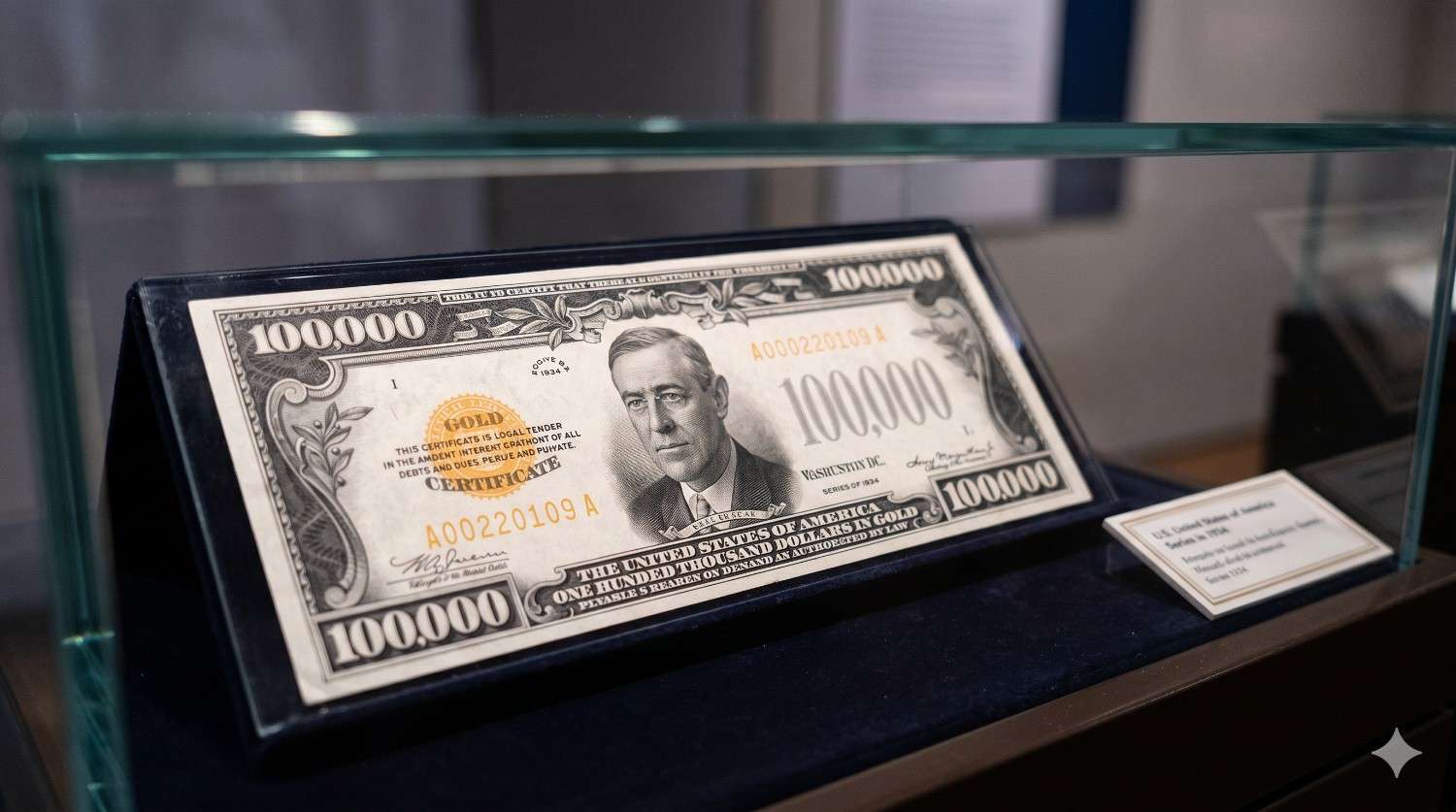
What Is the $100,000 Bill and Who Can Legally Own One?
No private individual can legally obtain a $100,000 bill through any standard channel. The note was never intended for public use, was never distributed through commercial banks, and has never appeared in any public auction or estate sale. Every specimen is accounted for and institutionally held.
The Gold Certificate Series of 1934 — What It Actually Was
The $100,000 bill was a Gold Certificate issued in 1934 by the U.S. Treasury. It featured a portrait of Woodrow Wilson and carried a face value of $100,000. The note was printed exclusively for transactions between Federal Reserve banks — specifically to settle interbank gold transfers during a period when the U.S. government was consolidating gold reserves under the Gold Reserve Act of 1934.
It was never a circulating currency. No member of the public ever received one as change, deposited one, or held one as savings. Its entire purpose was internal government accounting at the highest institutional level.
Why Private Citizens Cannot Legally Obtain One Today
Federal law prohibits private ownership of Gold Certificates in most circumstances. The Gold Reserve Act of 1934 required all gold and gold certificates to be surrendered to the Federal Reserve. While later legislation relaxed restrictions on some older gold coins and certain collectible notes, the $100,000 Gold Certificate was never included in those exemptions.
The legal reproduction standards for U.S. currency extend into this territory as well — even producing a replica of this note carries strict federal guidelines that govern size, material, and one-sided printing requirements.
Fewer than 100,000 of these notes were ever printed. Today, the surviving specimens are held exclusively by Federal Reserve banks and the Smithsonian Institution's National Numismatic Collection, where they are preserved as historical artifacts rather than monetary instruments.
Is It Considered Legal Tender or a Collectible?
The $100,000 bill is technically still legal tender under U.S. law — it has never been formally demonetized. However, that designation is functionally meaningless. No bank will accept one for deposit, no merchant would process one, and no private individual has the legal pathway to acquire one in the first place.
How the Federal Reserve Controls These Notes Today
The Federal Reserve maintains custody of all surviving $100,000 Gold Certificates. They are classified as government property, not collectible currency. This is a critical distinction: many other large-denomination notes — including the $500, $1,000, $5,000, and $10,000 bills — were discontinued in 1969 but remained in private hands and are now legally bought and sold by collectors.
The $100,000 bill never passed through that transition. It went from active institutional use directly into Federal Reserve vaults, bypassing the commercial banking system entirely. That chain of custody has never been broken.
What High-Value Currency Can Private Collectors Actually Own?
While the $100,000 bill remains out of reach, there is a robust and entirely legal market for high-denomination notes still available to collectors. The $500, $1,000, $5,000, and $10,000 Federal Reserve Notes are all legal to own, buy, and sell. Their numismatic value far exceeds their face value — a well-preserved $10,000 bill can sell for $30,000 to $140,000 at auction depending on condition and series year.
Collectors interested in rare currency should work with licensed numismatic dealers and verify authenticity through professional grading services such as PCGS Currency or PMG. These notes are genuine collectibles with active secondary markets, unlike the $100,000 bill, which exists entirely outside the collector ecosystem.
Conclusion
Owning a $100,000 bill is not a criminal act, but no legal mechanism exists for a private individual to acquire one. Institutional custody has been unbroken since 1934.
For those drawn to currency history for educational purposes, printing educational displays or historical reproductions offers a compliant and visually compelling way to engage with that material.
At AlphaGraphics Dallas, we help individuals and businesses produce high-quality prints, displays, and signage that meet federal reproduction guidelines — accurately, reliably, and on time.
Frequently Asked Questions
Was the $100,000 bill ever in public circulation?
No. The $100,000 Gold Certificate was issued exclusively for interbank transfers between Federal Reserve banks and was never distributed to the public or through commercial banking channels.
What is the highest denomination bill currently in circulation?
The $100 Federal Reserve Note is the highest denomination currently in active circulation. The U.S. stopped producing $500 and larger bills in 1969.
Can a museum legally display a $100,000 bill?
Yes. Licensed institutions such as the Smithsonian can display $100,000 bills as historical artifacts. The notes remain under Federal Reserve ownership even when on public exhibit.
What makes the $100,000 bill different from other large-denomination notes?
Unlike the $500 through $10,000 bills, the $100,000 Gold Certificate was never released into commercial circulation, making private ownership legally and practically impossible rather than simply rare.
Are reproductions or prints of the $100,000 bill legal to own?
Reproductions are legal under specific federal guidelines. They must be single-sided, printed at less than 75% or greater than 150% of actual size, and clearly marked as non-negotiable. Violations can carry federal counterfeiting penalties.
