
Signs and Banners: Complete Guide to Custom Signage for Business and Events
Trade show success starts long before you arrive at the convention center. The displays, graphics, and printed collateral you bring determine whether attendees stop at your booth or walk past it. Getting these materials right requires understanding your options, preparing files correctly, and working with a print partner who can deliver quality on a deadline.
Whether you are exhibiting at the Dallas Convention Center or shipping materials to a show across the country, this guide breaks down every category of trade show material you need. From large-format displays and banner stands to brochures, business cards, and promotional handouts, you will learn what works, what to order, and how to prepare your artwork for flawless results.
This guide covers display types, graphic formats, printed collateral essentials, file preparation requirements, material choices, turnaround timelines, and how to plan your entire trade show print order from start to finish.
What Are Trade Show Materials? 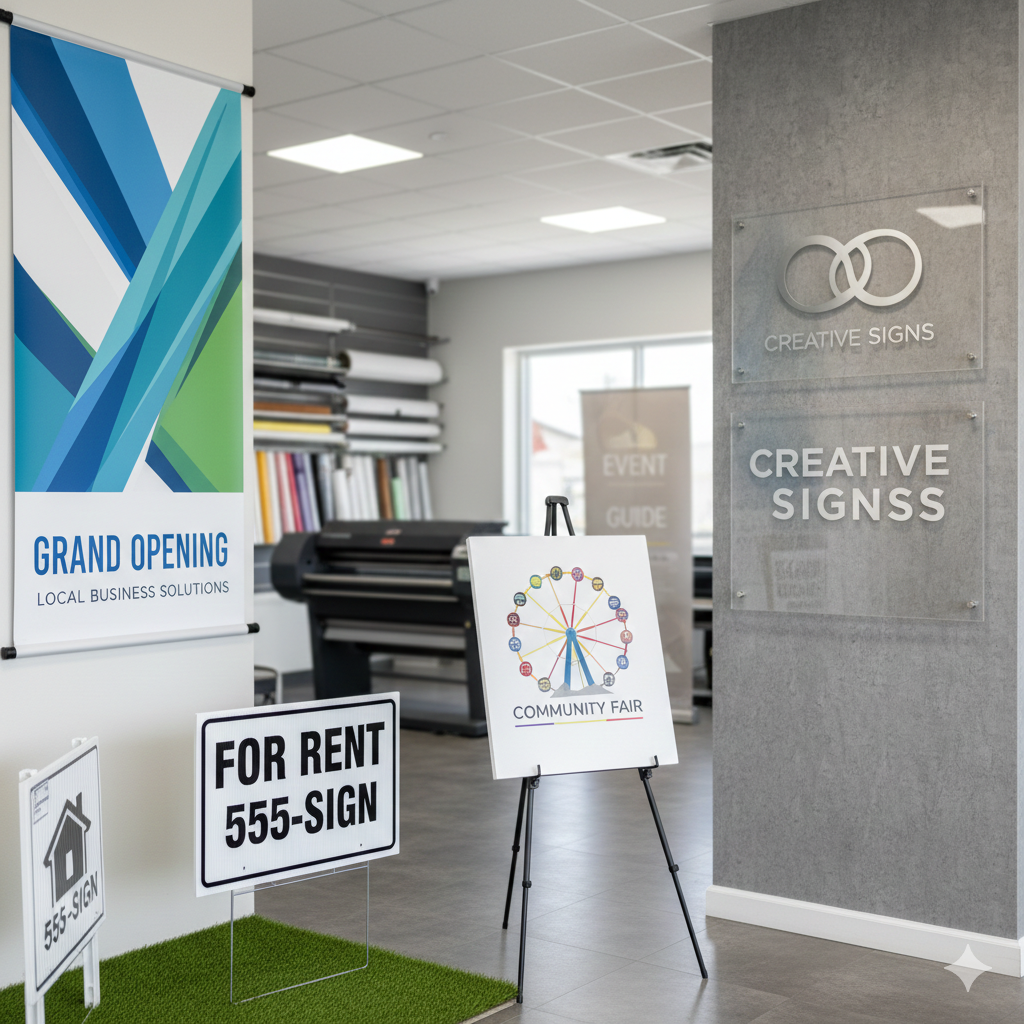
Trade show materials are the printed and structural products businesses use to present their brand, products, and messaging at exhibitions, conferences, and industry events. This category includes everything from the physical booth structure and large-format graphics to the brochures, business cards, and promotional items you hand to visitors.
These materials serve three core functions: attracting foot traffic to your booth, communicating your value proposition quickly, and giving attendees something tangible to take with them after the conversation ends. The right combination of displays, graphics, and collateral creates a cohesive brand experience that builds trust and generates leads.
Types of Trade Show Materials
Trade show materials fall into three primary categories:
Displays and booth structures include pop-up displays, retractable banner stands, tabletop displays, and modular exhibit systems. These form the physical framework of your booth and create the visual backdrop attendees see from across the show floor.
Graphics and large-format printing covers vinyl banners, fabric graphics, rigid signage, hanging signs, floor graphics, and any oversized visual element designed to grab attention. These are typically printed on specialty substrates using wide-format digital printers.
Printed collateral includes brochures, flyers, sell sheets, business cards, postcards, folders, catalogs, booklets, and promotional handouts. These are the leave-behind materials that keep your brand in front of prospects after the event.
Each category plays a distinct role. Displays create presence. Graphics communicate your message visually. Collateral delivers detailed information and drives follow-up action.
Why Quality Trade Show Materials Matter
Exhibiting at a trade show is a significant investment. Booth space, travel, staffing, and logistics add up quickly. Your materials are the visual and tactile representation of that investment, and they directly influence how attendees perceive your business.
Low-quality prints with pixelated images, flimsy banner stands that lean or collapse, and poorly designed brochures signal a lack of professionalism. Attendees make snap judgments. Research from the Center for Exhibition Industry Research shows that exhibitors have roughly three to five seconds to capture a passerby's attention. Your materials need to earn that attention instantly.
High-quality trade show materials also have a longer functional lifespan. Durable displays and well-printed graphics can be reused across multiple events, reducing your cost per show. Investing in professional-grade materials upfront saves money over time and ensures consistent brand presentation at every event.
Trade Show Displays and Booth Structures
Your display system is the foundation of your trade show presence. It defines the physical space, creates the visual backdrop, and sets the tone for every interaction at your booth. Choosing the right display depends on your booth size, budget, portability needs, and how frequently you exhibit.
Pop-Up Displays and Backwall Systems
Pop-up displays are one of the most popular trade show display solutions. They use a collapsible aluminum frame that expands into a curved or straight backwall, with printed graphic panels that attach using magnets or Velcro.
A standard pop-up display for a 10x10 booth typically measures 8 feet wide by 8 feet tall. Larger configurations are available for 10x20 or island booths. The graphic panels are usually printed on rollable fabric or semi-rigid composite material, making them easy to transport in padded cases.
Key advantages of pop-up displays:
Set up in 15 to 30 minutes without tools
Lightweight and portable with included carrying cases
Interchangeable graphic panels for different events or messaging
Professional, seamless appearance when assembled
Pop-up displays work best as backwall graphics behind a table or product display area. They provide a large, continuous visual surface that communicates your brand from a distance.
Retractable Banner Stands
Retractable banner stands, also called roll-up banners or pull-up banners, are the most versatile and portable trade show display option. The printed graphic retracts into a weighted base and extends upward on a telescoping pole, creating a freestanding vertical display.
Standard retractable banners are 33 inches wide by 81 inches tall, though sizes range from 24 inches to 60 inches wide. They weigh between 6 and 15 pounds depending on the model, and most come with a carrying bag for easy transport.
Common uses for retractable banner stands at trade shows:
Flanking a booth entrance or table
Highlighting specific products, services, or promotions
Creating visual dividers within larger booth spaces
Supplementing a pop-up display with additional messaging
Retractable banners are printed on vinyl, polypropylene, or fabric media. Vinyl offers the sharpest color reproduction and durability. Fabric provides a softer, glare-free finish that photographs well under exhibition lighting.
For most exhibitors, ordering two to four retractable banner stands provides flexible placement options and ensures your messaging is visible from multiple angles on the show floor.
Tabletop Displays
Tabletop displays are compact display systems designed to sit on top of a standard 6-foot or 8-foot exhibition table. They are ideal for smaller booth spaces, tabletop exhibitions, career fairs, and events where a full-size backwall is not practical.
Tabletop displays come in several formats:
Tabletop pop-ups use a miniature version of the full-size pop-up frame, typically 5 to 8 feet wide and 2 to 3 feet tall
Tabletop banner stands are shorter retractable banners designed for table-height visibility
Tabletop easel displays use rigid printed panels on a folding stand
These displays are extremely portable. Most fit in a small carrying case that qualifies as airline carry-on luggage, making them a practical choice for exhibitors who travel frequently.
Modular and Custom Exhibit Booths
For companies with larger budgets or frequent exhibition schedules, modular and custom exhibit systems offer maximum visual impact and flexibility. These systems use interchangeable structural components, including aluminum extrusion frames, fabric graphic walls, shelving, monitor mounts, lighting, and counters.
Modular systems can be reconfigured for different booth sizes. A single system might be set up as a 10x10 inline booth at one show and expanded to a 10x20 or 20x20 island booth at the next. This adaptability makes modular exhibits a cost-effective long-term investment for businesses that exhibit regularly.
Custom exhibit booths are designed and built to your exact specifications. They offer the highest level of brand customization but come with higher costs and longer production timelines. Custom booths are typically used by companies with dedicated trade show budgets and a calendar of multiple annual events.
Whether you choose a simple banner stand setup or a full custom exhibit, the key is matching your display system to your booth size, event frequency, and brand presentation goals.
Trade Show Graphics and Large-Format Printing
Graphics are what make your booth visible. While the display structure provides the framework, the printed graphics deliver your brand identity, messaging, and visual appeal. Large-format printing technology allows you to produce high-resolution images and text on a wide range of substrates, from flexible vinyl to rigid board materials.
Vinyl Banners and Hanging Signs
Vinyl banners remain one of the most cost-effective and versatile large-format print products for trade shows. They are printed on durable PVC vinyl material using solvent, eco-solvent, or UV-curable inks that resist fading and moisture.
Common vinyl banner applications at trade shows:
Overhead hanging banners visible from across the exhibition hall
Booth backdrop banners mounted on pipe-and-drape systems
Outdoor event banners for entrance areas and wayfinding
Table drapes and throws printed with full-color graphics
Standard vinyl banner material is 13-ounce scrim vinyl, which offers a good balance of durability and print quality. For hanging signs and double-sided applications, blockout vinyl prevents light from showing through.
Vinyl banners can be finished with grommets, pole pockets, or hemmed edges depending on how they will be mounted. For trade show hanging signs, lightweight fabric or mesh vinyl is often preferred to meet venue weight restrictions for overhead rigging.
Fabric Graphics and Tension Displays
Fabric printing has become increasingly popular for trade show graphics. Dye-sublimation printing transfers ink directly into polyester fabric, producing vibrant, high-resolution graphics with a soft, professional finish.
Advantages of fabric graphics over vinyl:
Wrinkle-resistant and machine washable
Lightweight for easy shipping and reduced freight costs
No glare under exhibition lighting, which improves photography
Pillowcase-style graphics slip over frames for a seamless, taut appearance
Fabric graphics are the standard for tension fabric displays, which use aluminum tube frames with stretch fabric graphics that pull over the frame like a pillowcase. These displays create a clean, modern look without visible seams or hardware.
Tension fabric displays are available as backwalls, freestanding towers, counters, and hanging structures. They are a popular choice for exhibitors who want a polished, contemporary booth aesthetic.
Foam Board, PVC, and Rigid Signage
Rigid signage materials are used for signs, directional displays, product information panels, and decorative elements within a trade show booth. Common rigid substrates include:
Foam board (Gatorboard): Lightweight, rigid, and easy to mount. Ideal for temporary signage and display boards. Available in thicknesses from 3/16 inch to 1 inch.
PVC board (Sintra): A durable, moisture-resistant plastic board. Heavier than foam board but more durable for repeated use. Available in white, black, and colors.
Acrylic and polycarbonate: Clear or colored plastic panels used for premium signage, dimensional lettering, and backlit displays.
Aluminum composite (Dibond): A rigid, lightweight panel with an aluminum face. Used for high-end signage that needs to withstand repeated handling and transport.
Corrugated plastic (Coroplast): An inexpensive, lightweight option for temporary signs and directional displays.
Rigid signs can be printed directly using UV flatbed printers or produced as printed vinyl applied to the substrate surface. Direct printing offers a cleaner finish, while vinyl application allows for easier graphic changes.
Vehicle Wraps and Floor Graphics
While not traditional booth elements, vehicle wraps and floor graphics are increasingly used at trade shows and outdoor exhibition events to extend brand visibility beyond the booth space.
Floor graphics are printed on vinyl with a slip-resistant laminate and applied directly to the exhibition hall floor. They can be used to create pathways leading to your booth, display product images at scale, or reinforce branding in high-traffic areas. Most exhibition venues require floor graphics to have a certified slip rating, so always confirm material specifications with your printer.
Vehicle wraps are relevant for exhibitors who display vehicles as part of their booth or park branded vehicles outside the venue. Full or partial vehicle wraps are printed on cast vinyl and professionally installed to conform to the vehicle's contours.
Both products require precise file preparation and professional installation to achieve a clean, professional result.
Printed Collateral for Trade Shows
Printed collateral is the material attendees take with them. While your displays and graphics attract attention and start conversations, your collateral continues the conversation after the show. Well-designed, professionally printed leave-behind materials reinforce your brand, provide detailed product or service information, and give prospects a reason to follow up.
Brochures, Flyers, and Sell Sheets
These are the core informational handouts for any trade show booth.
Brochures are multi-panel printed pieces, typically tri-fold or bi-fold, printed on heavier card stock or coated paper. They provide enough space to tell your brand story, outline services, and include contact information. Standard brochure sizes include 8.5 x 11 inches (letter) and 8.5 x 14 inches (legal), folded to fit in a pocket or folder.
Flyers are single-sheet, one- or two-sided prints. They are the most cost-effective collateral option and work well for promoting a specific product, event, or offer. Standard flyer size is 8.5 x 11 inches.
Sell sheets are similar to flyers but are designed with a more structured layout focused on a single product or service. They typically include specifications, features, benefits, pricing, and a call to action. Sell sheets are commonly printed on glossy or matte coated stock for a premium feel.
For trade shows, plan to bring more collateral than you think you need. A general guideline is to prepare 1.5 to 2 times the number of expected booth visitors. Running out of materials on the second day of a three-day show is a missed opportunity.
Business Cards and Postcards
Business cards remain essential at trade shows. They are the fastest way to exchange contact information and leave a professional impression. Standard business card size in the United States is 3.5 x 2 inches, printed on 14pt or 16pt card stock.
Postcards serve a dual purpose at trade shows. Oversized postcards (4 x 6 or 5 x 7 inches) can function as mini sell sheets, appointment reminders, or promotional offers. They are more substantial than a flyer and more likely to be kept by the recipient.
Consider adding a QR code to your business cards and postcards that links to a landing page, digital portfolio, or contact form. This bridges the gap between your printed materials and your digital presence.
Folders, Catalogs, and Booklets
For businesses with extensive product lines or complex service offerings, folders, catalogs, and booklets provide the space to present detailed information in an organized format.
Presentation folders hold loose inserts like sell sheets, brochures, and business cards. A custom-printed folder with pockets creates a professional package that keeps your materials together. Standard folder size is 9 x 12 inches with one or two interior pockets.
Catalogs are multi-page, bound publications that showcase your full product line with descriptions, images, and specifications. They are typically saddle-stitched (stapled) or perfect-bound (glued spine) depending on page count.
Booklets are smaller-format bound pieces, often used for company profiles, case studies, or technical guides. They provide more depth than a brochure without the production cost of a full catalog.
These materials are best reserved for qualified leads rather than distributed to every passerby. They cost more to produce and carry more weight in your shipping, so use them strategically.
Promotional Items and Custom Handouts
Promotional items, also called swag or giveaways, add a memorable touchpoint to your trade show presence. Common promotional items include:
Branded pens, notepads, and sticky notes
Tote bags and drawstring backpacks
USB drives and phone accessories
Stickers, magnets, and buttons
Custom-printed packaging or boxes
The most effective promotional items are useful, portable, and clearly branded. Avoid items that will be discarded before the attendee leaves the venue. A high-quality branded pen or a reusable tote bag has a longer shelf life than a novelty toy.
Custom handouts can also include printed materials with a unique format, such as die-cut shapes, folded mailers, or interactive pieces with peel-off elements. These stand out from standard collateral and increase the likelihood of being kept.
File Preparation and Print-Ready Artwork Guidelines
File preparation is where many trade show print orders go wrong. Submitting incorrect files causes delays, reprints, and additional costs. Understanding the basic requirements for print-ready artwork ensures your materials are produced correctly the first time.
Resolution, Color Mode, and Bleed Requirements
Resolution refers to the number of pixels per inch (PPI or DPI) in your image files. For standard printed collateral like brochures and business cards, artwork should be set to 300 DPI at the final print size. For large-format graphics like banners and backwall displays, 150 DPI is typically sufficient because these materials are viewed from a greater distance. Very large graphics (over 8 feet wide) can often be printed at 100 DPI or even 72 DPI without visible quality loss.
Color mode must be set to CMYK (Cyan, Magenta, Yellow, Black) for all print files. RGB (Red, Green, Blue) is used for screen display and will produce inaccurate colors when printed. Converting your files from RGB to CMYK before submission prevents unexpected color shifts.
Bleed is the extra area of artwork that extends beyond the trim line. Bleed ensures that when the printed piece is cut to its final size, there are no white edges. Standard bleed for printed collateral is 0.125 inches (1/8 inch) on all sides. For large-format prints, bleed requirements vary by product but typically range from 0.5 to 1 inch.
Common File Formats and Templates
Most professional print providers accept the following file formats:
PDF (Preferred): High-resolution PDF files with fonts embedded and images at full resolution. PDF/X-1a is the industry standard for print-ready files.
AI (Adobe Illustrator): Native vector files with all fonts outlined and linked images included.
PSD (Adobe Photoshop): Flattened or layered files at the correct resolution and color mode.
EPS: Encapsulated PostScript files, commonly used for vector graphics and logos.
TIFF: High-resolution raster images, suitable for photographic content.
Avoid submitting: JPEG files (lossy compression reduces quality), PNG files (RGB only, no CMYK support), Microsoft Word or PowerPoint files (not designed for professional print production), and low-resolution images downloaded from websites.
Many print providers offer downloadable templates for common products like business cards, brochures, banner stands, and pop-up displays. Using these templates ensures your artwork is sized correctly with proper bleed, safe zones, and fold lines marked.
How to Avoid Costly File Errors
The most common file preparation mistakes that cause trade show print delays:
Low-resolution images. Images pulled from websites are typically 72 DPI and will appear blurry or pixelated when printed. Always use original, high-resolution source files.
Missing fonts. If your fonts are not embedded in the PDF or outlined in the Illustrator file, the printer's system may substitute a different font, changing your layout. Always embed or outline fonts before exporting.
Incorrect dimensions. Submitting artwork at the wrong size requires resizing, which can affect resolution and layout proportions. Always confirm the exact print dimensions with your provider before designing.
No bleed or safe zone. Text or important design elements placed too close to the trim edge risk being cut off. Keep critical content at least 0.25 inches inside the trim line.
RGB color mode. Colors that look vibrant on screen may print dull or shifted in CMYK. Always design in CMYK or convert before final export.
If you are unsure about your file preparation, ask your print provider to review your files before production begins. A quick preflight check can save days of delay and hundreds of dollars in reprints.
Choosing the Right Materials and Finishes
The substrate, coating, and finish you choose for your trade show materials affect their appearance, durability, and cost. Understanding your options helps you make informed decisions that align with your brand standards and budget.
Paper Stocks, Coatings, and Laminates
Paper stock weight is measured in pounds (lb) or points (pt) in the United States. Heavier stocks feel more substantial and professional.
Text weight (70-100 lb): Used for brochures, flyers, and catalog interior pages. Flexible and easy to fold.
Cover weight (80-130 lb / 14-16pt): Used for business cards, postcards, folder covers, and sell sheets. Rigid enough to hold its shape.
Card stock (16-24pt): Used for premium business cards, hang tags, and rigid inserts. Thick and durable.
Coatings protect the printed surface and enhance visual appearance:
Gloss coating: High-shine finish that makes colors pop. Best for photo-heavy designs.
Matte coating: Soft, non-reflective finish. Easier to read under bright lighting and gives a sophisticated look.
Satin/Silk coating: A middle ground between gloss and matte. Slight sheen without heavy reflection.
Soft-touch laminate: A velvety, tactile finish that creates a premium feel. Popular for business cards and high-end collateral.
UV spot coating: A glossy coating applied to specific areas of the design (like a logo or image) while the rest remains matte. Creates a striking visual and tactile contrast.
Laminates add a protective layer over the entire printed surface. They are essential for materials that will be handled frequently, such as trade show collateral that gets passed around a booth all day. Lamination prevents scuffing, moisture damage, and ink transfer.
Indoor vs. Outdoor Material Considerations
If your trade show includes outdoor elements, such as an outdoor exhibition area, parking lot signage, or entrance banners, your material choices need to account for weather exposure.
Indoor materials prioritize visual quality and cost efficiency. Standard vinyl, fabric, foam board, and coated paper stocks perform well in climate-controlled exhibition halls.
Outdoor materials must resist UV fading, moisture, wind, and temperature changes. Recommended outdoor substrates include:
13-ounce or 18-ounce scrim vinyl with UV-resistant inks
Mesh vinyl for windy locations (allows air to pass through)
Aluminum composite panels for rigid outdoor signs
Corrugated plastic for temporary outdoor directional signs
Weatherproof laminated prints for any paper-based outdoor signage
Always confirm whether your event has outdoor components and plan your material selections accordingly. Bringing indoor-only materials to an outdoor setup leads to damage, fading, and wasted budget.
Matching Materials to Your Brand and Budget
Your material choices should reflect your brand positioning. A luxury brand exhibiting at a high-end industry event should invest in soft-touch laminated business cards, fabric tension displays, and perfect-bound catalogs. A startup on a tight budget can achieve a professional look with retractable banner stands, glossy sell sheets, and standard business cards on 16pt stock.
Budget-conscious material choices that still look professional:
Retractable banner stands with vinyl graphics (reusable for multiple shows)
Tri-fold brochures on 100 lb gloss text stock
Business cards on 16pt card stock with gloss or matte coating
Foam board signs for in-booth directional or informational displays
Premium material choices for maximum impact:
Tension fabric displays with dye-sublimation graphics
Soft-touch laminated business cards on 24pt stock
Perfect-bound catalogs with spot UV cover
Custom presentation folders with foil stamping
The best approach is to allocate your budget based on visibility and longevity. Spend more on display elements that will be reused and seen from a distance. Use cost-effective options for high-volume handout materials.
Turnaround Times and Planning Your Trade Show Print Order
Timing is one of the most critical factors in trade show preparation. Late materials mean scrambling for rush production, paying premium shipping rates, or worse, arriving at your booth without everything you need.
Standard vs. Rush Production Timelines
Production timelines vary by product type and complexity:
Rush production is available from most professional print providers, but it comes with additional fees, typically 25% to 50% above standard pricing. Planning ahead eliminates rush charges and gives you time to review proofs and make corrections.
Trade Show Printing Checklist and Timeline
Use this timeline to plan your trade show print order:
8-12 weeks before the show:
Finalize booth layout and display requirements
Begin graphic design for displays and collateral
Order custom exhibit structures if needed
6-8 weeks before the show:
Finalize all artwork and copy
Submit files for large-format displays and custom items
Order promotional items (many have 3-4 week production times)
4-6 weeks before the show:
Submit files for printed collateral (brochures, sell sheets, catalogs)
Order retractable banner stands and pop-up display graphics
Confirm shipping addresses and delivery dates
2-4 weeks before the show:
Review and approve all proofs
Confirm production is on schedule
Arrange shipping and freight logistics
1-2 weeks before the show:
Receive and inspect all materials
Verify quantities and quality
Pack and ship to venue or prepare for transport
Day of setup:
Arrive with a setup plan and all necessary hardware
Test all display components
Arrange collateral and promotional items in the booth
Shipping, Delivery, and On-Site Logistics
Getting your materials to the venue on time and in good condition requires advance planning.
Shipping to a convention center typically requires using the venue's designated freight carrier or advance shipping service. Most convention centers have specific receiving windows and charge for material handling. Contact the venue or show organizer for shipping instructions, deadlines, and fees.
Advance shipping means sending your materials to the venue days or weeks before the event. This is the safest option for large or heavy items. Label all packages clearly with your company name, booth number, and event name.
Hand-carry materials are items you bring personally, such as business cards, brochures, and small banner stands. This is the most reliable method for critical items you cannot afford to lose in shipping.
Tip: Always pack a "survival kit" that you carry personally, containing business cards, a small tabletop banner, sell sheets, and basic booth supplies (tape, scissors, zip ties, extension cord). If your shipped materials are delayed, you can still operate your booth at a basic level.
How AlphaGraphics Dallas Supports Your Trade Show Success
Preparing for a trade show involves coordinating multiple print products across different formats, substrates, and deadlines. Working with a single print provider who handles everything simplifies the process and ensures consistency across all your materials.
Full-Service Trade Show Printing Under One Roof
AlphaGraphics Dallas produces the full range of trade show materials in-house, from large-format banner stands and pop-up display graphics to brochures, business cards, sell sheets, and promotional items. Having all your trade show printing handled by one provider eliminates the complexity of coordinating multiple vendors, matching colors across different printers, and managing separate timelines.
Our team reviews your files, recommends the right materials for your specific event, and manages production to meet your deadline. If your files need adjustments, we catch issues during preflight review before they become costly problems on press.
Local Expertise and Fast Turnaround in Dallas
Being based in Dallas means you can visit our facility, review material samples in person, and pick up finished orders directly. For exhibitors attending shows at the Kay Bailey Hutchison Convention Center, the Dallas Market Center, or other local venues, working with a local printer eliminates shipping risk and gives you the flexibility to make last-minute changes or additions.
Our standard turnaround covers most trade show material needs, and rush production is available when timelines are tight. We understand the pressure of trade show deadlines and build our production schedule to deliver on time, every time.
Whether you need a single retractable banner or a complete booth package with displays, graphics, and thousands of printed collateral pieces, AlphaGraphics Dallas has the equipment, expertise, and production capacity to handle your trade show printing from file to finish.
Conclusion
Trade show materials span three essential categories: display structures that create your booth presence, large-format graphics that communicate your brand visually, and printed collateral that keeps your message in prospects' hands long after the event. Getting the right combination of these materials, prepared correctly and delivered on time, is what separates a productive trade show from a missed opportunity.
Planning ahead, preparing print-ready files, and choosing materials that match your brand and budget are the practical steps that make trade show printing straightforward. Every decision, from paper stock to display type, contributes to how attendees perceive your business on the show floor.
We help Dallas businesses show up to every trade show with professional, high-quality materials produced under one roof. Contact AlphaGraphics Dallas to start your trade show print order and get expert guidance on displays, graphics, and collateral that make your booth stand out.
Frequently Asked Questions
What materials do I need for a 10x10 trade show booth?
A standard 10x10 booth typically requires a backwall display (pop-up or retractable banner stands), a table cover or tablecloth, and printed collateral like brochures and business cards. Adding one or two freestanding banner stands and a small rigid sign for your table completes the setup.
How far in advance should I order trade show materials?
Plan to have all artwork finalized and submitted to your printer at least four to six weeks before the event. Custom displays and promotional items may need eight to twelve weeks. Starting early avoids rush fees and gives you time to review proofs.
What file format is best for large-format trade show graphics?
High-resolution PDF files in CMYK color mode are the preferred format for most large-format print providers. Adobe Illustrator (.AI) and Photoshop (.PSD) files are also accepted. Ensure images are at least 150 DPI at the final print size.
Can I print trade show banners and collateral at the same place?
Yes. Full-service print providers like AlphaGraphics Dallas produce both large-format graphics and standard printed collateral in-house. Ordering everything from one provider ensures color consistency and simplifies your timeline.
How much do trade show display materials typically cost?
Costs vary widely by product. A single retractable banner stand with printed graphic typically ranges from $150 to $400. Pop-up display systems range from $500 to $2,000. Printed collateral like brochures and business cards are priced per quantity, with costs decreasing at higher volumes.
What is the difference between pop-up displays and banner stands?
Pop-up displays use a collapsible frame that creates a wide backwall graphic, typically 8 to 10 feet across. Banner stands are freestanding vertical displays, usually 33 inches wide, that retract into a portable base. Pop-ups provide a larger visual surface, while banner stands offer more placement flexibility.
Do I need different materials for indoor vs. outdoor trade shows?
Yes. Indoor materials like standard vinyl, foam board, and coated paper work well in climate-controlled venues. Outdoor events require UV-resistant inks, heavier vinyl substrates, weatherproof laminates, and wind-resistant mounting to prevent damage from sun, rain, and wind exposure.
