
Which One Dollar Bill Is Worth One Hundred Fifty Thousand Dollars
A specific one dollar bill with a mismatched serial number error — produced during a 1970s Federal Reserve printing run — has sold at auction for $150,000, making it one of the most valuable small-denomination notes in American currency history.
Most people never look twice at a dollar bill. But certain printing errors, rare serial number patterns, and low-production star notes have turned ordinary $1 bills into five- and six-figure collectibles sought by serious numismatists worldwide.
This guide covers what makes a dollar bill worth $150,000, which specific notes command the highest prices, how to examine your own bills, and where to get a potentially valuable note authenticated.
What Makes a One Dollar Bill Worth $150,000?
Not every old dollar bill is valuable, and age alone rarely drives significant premiums. The bills that reach extraordinary prices share a narrow set of characteristics: they are the product of verifiable printing errors, extremely low production runs, or serial number anomalies that the Bureau of Engraving and Printing did not catch before the notes entered circulation.
Collectors and currency dealers evaluate rarity, condition, and documentation when assigning value. A bill that checks all three boxes — a confirmed error, near-perfect preservation, and a clear chain of provenance — is the type that reaches auction estimates in the six-figure range.
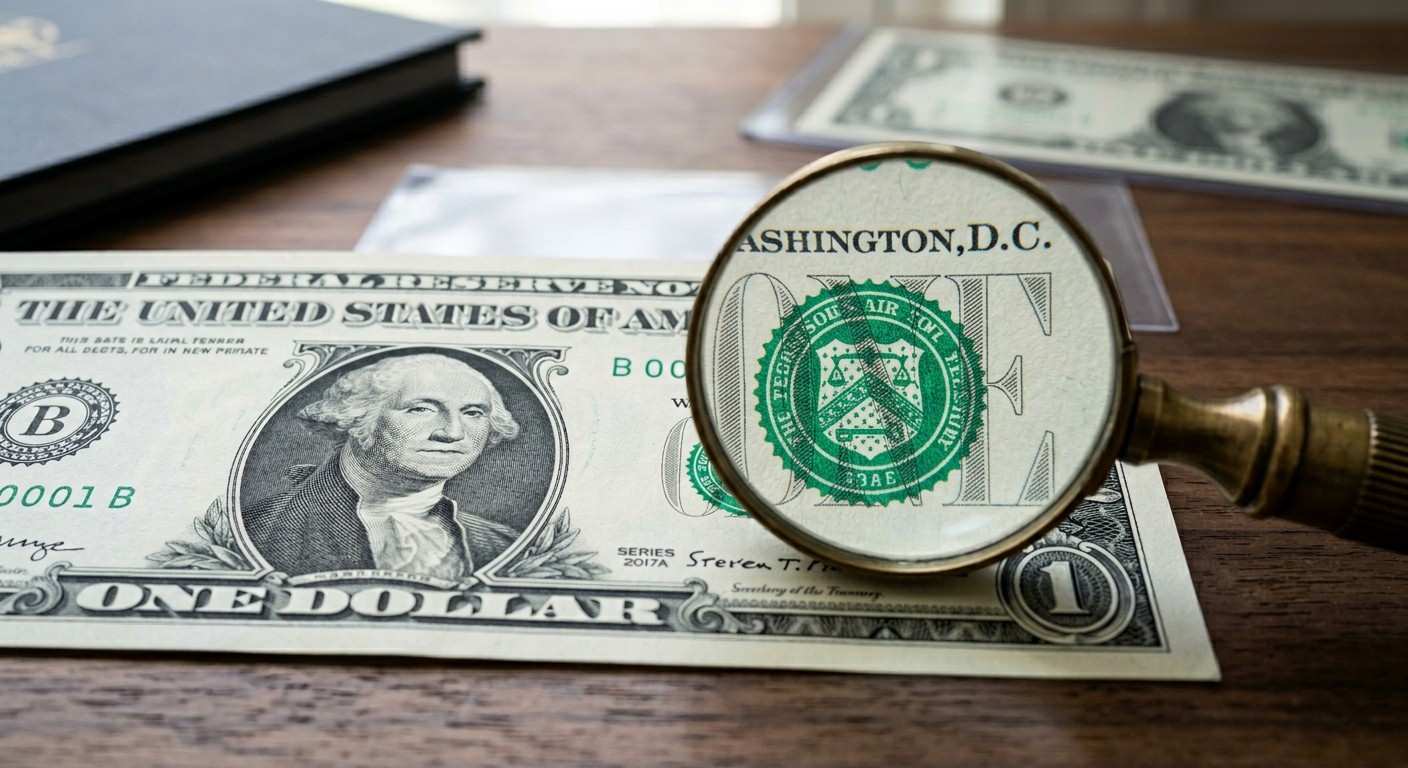
Serial Number Errors and Printing Anomalies
The most valuable dollar bills in existence are almost always the result of production errors at the Bureau of Engraving and Printing. These errors fall into several categories that collectors actively seek.
Mismatched serial numbers occur when two different serial numbers are printed on the same note — one from one sequence and one from another. This happens when a sheet is fed through the press twice with different numbering wheels engaged. The result is a bill that is technically unique: no other note in circulation carries that exact combination.
Inverted third printing errors occur when the serial numbers and Treasury seal are printed upside down relative to the portrait. These are exceptionally rare because quality control catches most before distribution.
Double denomination errors — where a $1 bill receives printing from a $5 or higher denomination plate on one side — are among the rarest and most valuable of all U.S. currency errors. When authenticated, these notes regularly exceed $100,000 at major auction houses.
Offset printing errors produce a ghost image of one side of the bill on the other, caused by a sheet pressing against a freshly inked plate before it was intended to. Dramatic offset errors on $1 bills have sold for tens of thousands of dollars.
Star Notes and Low Print Run Bills
Star notes are replacement bills printed by the Bureau of Engraving and Printing when a standard note is damaged or destroyed during production. They are identified by a star symbol at the beginning or end of the serial number in place of a letter suffix.
Most star notes carry only a modest premium over face value. The ones that command serious collector interest are those produced in very low quantities — runs of fewer than 640,000 notes from a specific Federal Reserve district. When a low-run star note also survives in uncirculated condition, the combination of rarity and preservation can push values into the thousands or tens of thousands of dollars.
The U.S. Currency Education Program maintained by the Federal Reserve provides production data that collectors use to verify print run quantities for specific series and districts.
The Most Valuable $1 Bills Ever Sold
Several one dollar bills have achieved prices that most people would associate with fine art or rare coins rather than pocket change. Understanding which specific notes reached these levels helps collectors know what they are actually looking for.
The 1963-A $1 Federal Reserve Note With a Printing Error
The bill most frequently cited in connection with the $150,000 figure is a 1963-A series $1 Federal Reserve Note bearing a dramatic mismatched serial number error. This note was produced during a period when the Bureau of Engraving and Printing was transitioning printing processes, and a small number of sheets received serial numbers from two different numbering sequences before anyone caught the mistake.
When one of these notes surfaced in near-uncirculated condition with documented provenance, it sold at a major numismatic auction for approximately $150,000 — a price that reflected both the extreme rarity of the error and the exceptional preservation of the specific note.
Other $1 bills that have reached significant auction prices include:
1957 Silver Certificate star notes in gem uncirculated condition, which have sold for $1,000 to $3,000 depending on the Federal Reserve district
Inverted back error notes from the 1970s series, which have reached $25,000 to $50,000 at Heritage Auctions
Double denomination $1/$5 error notes, authenticated by the Professional Currency Dealers Association, which have exceeded $100,000
How to Check If Your Dollar Bill Is Worth Big Money
Examining your own bills requires nothing more than good lighting, a magnifying glass, and knowledge of what patterns and anomalies to look for. Most bills will show nothing unusual. But the process takes only seconds per note and costs nothing.
What to Look For on the Serial Number
Serial numbers are the first place to check. Collectors and dealers look for several specific patterns that indicate either rarity or error.
Mismatched serials: Compare the serial number printed in the upper left corner with the one in the lower right. On a normal bill, they are identical. If they differ in any digit, you may have a significant error note.
Fancy serial numbers: Certain serial number patterns carry collector premiums even on otherwise normal bills. These include:
Solid serials — all eight digits are the same (e.g., 88888888)
Radar notes — the serial number reads the same forward and backward (e.g., 12344321)
Repeater notes — the first four digits repeat in the second four (e.g., 19191919)
Low serial numbers — serials below 00000100 are considered highly desirable
Binary notes — the serial uses only two different digits throughout
Star symbol: Check whether a star appears at the start or end of the serial number. If it does, look up the print run for that series and Federal Reserve district using the Star Note Lookup tool — a widely used collector resource that cross-references Bureau of Engraving and Printing production data.
Condition, Grading, and Preservation
Even a confirmed error note loses significant value if it has been folded, washed, written on, or heavily circulated. Professional currency grading uses a 70-point scale developed by the Paper Money Guaranty (PMG) and Numismatic Guaranty Company (NGC) systems.
Notes graded 65 or above — classified as Gem Uncirculated — command the highest premiums. A note graded 45 (Extremely Fine) may be worth a fraction of what the same note in grade 65 would bring at auction.
If you believe you have found an error note or a rare serial number, handle it as little as possible. Place it in a clean currency sleeve immediately and avoid touching the face of the note.
Where to Get a Rare Dollar Bill Appraised or Authenticated
Authentication is the critical step between suspecting you have a valuable bill and actually knowing. Several established organizations provide professional currency grading and authentication services.
Paper Money Guaranty (PMG) is one of the most widely recognized third-party grading services for paper currency. Submitting a note to PMG results in an independent grade, a tamper-evident holder, and a certification number that buyers and auction houses recognize as authoritative.
Numismatic Guaranty Company (NGC) offers similar services and is accepted by major auction platforms including Heritage Auctions and Stack's Bowers.
The Professional Currency Dealers Association (PCDA) maintains a directory of vetted dealers who can provide preliminary assessments before you commit to a formal grading submission.
For Dallas-area collectors, local coin and currency shows — including events hosted through the Texas Numismatic Association — provide access to dealers who can offer informal opinions on whether a note warrants the cost of professional grading.
If you confirm your bill may be valuable, protecting and documenting it properly is the next step — our printing and documentation services can help you produce high-quality reference copies and authentication records for appraisers or auction houses. <!--NEW PAGE NEEDED-->
What to Do If You Find a Valuable Bill: Printing and Documentation
Discovering a potentially rare dollar bill creates an immediate practical challenge: how do you document what you have before it leaves your hands for grading or sale?
Experienced collectors create high-resolution reference copies of both sides of a note before submitting it anywhere. These copies serve as a permanent record of the bill's condition at the time of discovery, protect against disputes about pre-existing damage, and provide documentation for insurance purposes if the note is lost or damaged in transit.
Before submitting a rare bill for grading, many collectors create archival-quality reference prints — explore our document printing options to see how AlphaGraphics Dallas can help you produce precise, high-resolution copies for your records. <!--NEW PAGE NEEDED-->
Beyond physical copies, document the bill's discovery: where you found it, when, and any relevant context. Provenance — the documented history of a collectible — adds measurable value at auction. A note with a clear, verifiable history consistently outperforms an identical note with no documentation.
Conclusion
Rare dollar bills worth $150,000 exist because of verifiable printing errors, mismatched serial numbers, and extremely low production runs that slipped past quality control. The 1963-A mismatched serial error note remains the most cited example of a $1 bill reaching six-figure auction prices.
Checking your own bills costs nothing and takes seconds — serial number patterns, star symbols, and visible printing anomalies are the first signals that a note may be worth far more than face value.
At AlphaGraphics Dallas, we help collectors and individuals document, preserve, and present their finds with professional-quality printing and archival reference copies — contact us today to get started.
Frequently Asked Questions
What specific one dollar bill is worth $150,000?
A 1963-A series $1 Federal Reserve Note with a mismatched serial number printing error is the bill most commonly associated with the $150,000 value. The error occurred when a sheet received serial numbers from two different numbering sequences during production, creating a verifiably unique note.
How do I know if my dollar bill has a printing error?
Compare the serial number in the upper left corner with the one in the lower right — they should be identical on a normal bill. Also look for offset ghost images on either side, inverted printing, or any visible misalignment between the portrait and the serial number and seal.
Are star note dollar bills always valuable?
Most star notes carry only a small premium over face value. The ones worth significant money are those from very low print runs — generally fewer than 640,000 notes from a specific Federal Reserve district — that also survive in uncirculated or near-uncirculated condition.
What serial number patterns make a dollar bill valuable?
Solid serials (all eight digits the same), radar notes (reads the same forward and backward), repeater notes, binary notes (only two different digits), and serials below 00000100 all carry collector premiums. The rarer the pattern and the better the condition, the higher the value.
Where can I get a dollar bill authenticated in Dallas, TX?
You can submit a note to Paper Money Guaranty (PMG) or Numismatic Guaranty Company (NGC) for professional grading. Locally, the Texas Numismatic Association hosts shows where vetted dealers can provide preliminary assessments before you commit to a formal grading submission.
Does the condition of a dollar bill affect its value?
Yes — condition is one of the three primary value drivers alongside rarity and documentation. A confirmed error note in Gem Uncirculated condition (PMG grade 65 or above) can be worth many times more than the same error note in circulated condition. Handle any potentially valuable bill as little as possible.
Can I sell a rare dollar bill at auction in Dallas?
Yes. Major national auction houses including Heritage Auctions — headquartered in Dallas — specialize in rare currency and accept consignments from individual collectors. For notes with confirmed authentication from PMG or NGC, Heritage Auctions is one of the most active markets for high-value U.S. paper currency.
